
Top 10 Tips To Assess PAT Compliance in Stafford
The regulatory landscape for Portable Appliance Testing (PAT) in the UK is fundamentally different from the prescriptive requirements governing fixed electrical installations or fire safety equipment. PAT testing, unlike fire extinguisher service, is governed by an broader health-and-safety framework that places more emphasis on risk assessment and duty to care than on mandatory testing schedules. Electricity at Work Regulations of 1989 state that portable equipment and electrical systems must be maintained so as to prevent any danger. However, the Regulations do not specify how this maintenance should be achieved, nor do they mandate a specific testing frequency or methodology. As a result, the employer is required to perform an adequate and appropriate risk assessment before determining a maintenance and testing regime. Compliance can't be proven by just a bunch of test certificate. Instead, it must include a demonstrated process of decision-making based on risk, competent execution, and thorough documentation.
1. Electricity at Work Regulations, 1989: The Legal Basis
Regulation 4(2), of the Electricity at Work Regulations, 1989, is the cornerstone for PAT compliance. It states: "As necessary to prevent dangers, all systems must be maintained to prevent such dangers, as far as it is reasonably practicable." This places an absolute responsibility on employers to maintain all electrical equipment. The term “system” includes portable appliances. The regulations don't mention "PAT tests" in particular; instead, they require "maintenance," a concept that encompasses visual inspection, user check, and combined inspection and test. The frequency and type of maintenance required are determined by the risk assessment, not by a fixed legal timetable.
2. Act 1974 on Health and Safety at Work Act 1974
The Health and Safety at Work, etc. The 1974 Act is the main legislation which establishes employers' general duties towards their employees and other people. In section 2 of the Act, employers are required to provide, as far as it is reasonable, for the health, safety, and welfare of their employees. Electrical equipment is included in the safe operation of electrical systems and plant. Section 3 extends their duty to other people, like visitors, contractors, or members of the general public. PAT testing is an important method to fulfill these general duties, as it provides a structured way of ensuring that electrical equipment is safe.
3. Guidance and Best Practice: The IET Code of Practice for In-Service Inspection and Testing of Electrical Equipment
Even though it is not a legal document, the Institution of Engineering and Technology Code of Practice has become the standard for best PAT test practices. The code provides detailed guidelines on implementing an appropriate maintenance regime.
Definitions for appliance types and classes
Detailed procedures for formal visual inspections and combined inspection and testing.
The equipment type, operating environment and recommended inspection and test frequencies will determine the initial frequency.
Criteria for determining whether a test result is a pass or a fail
Courts and Health and Safety Executive Inspectors (HSE), who will judge whether the maintenance regime of a dutyholder is "suitable and enough," will use this standard. A deviation from the code that is not accompanied by a documented and robust risk-based justification can be interpreted as non-compliance with the regulations.
4. Risk Assessment Is Priority No. 1
The HSE explicitly advocates a risk-based approach to PAT testing, moving away from the outdated concept of blanket annual testing for all equipment. The dutyholder is required to carry out a risk assessment before determining the nature and frequency of testing and inspection. Key factors influencing this assessment include:
Equipment type. A Class I appliance, in a workshop or low-risk environment, may require regular formal testing.
Construction sites, warehouses and workshops are all high-risk environments. Offices and hotels are generally lower risk.
Equipment users: Are they trained staff members or the general public?
What is the history of your appliance? Is it new or has it been frequently damaged in the past?
A compliant system is defined by this risk assessment, not by the volume of tests conducted.
5. The Concept of "Competence" for Testers
Regulation 16 of the Electricity at Work Regulations (1989) states that anyone working with electrical equipment must have the required technical knowledge to avoid harm. For PAT testing, "competence" does not necessarily require a formal qualification, but the tester must have:
Knowledge of electricity is essential.
Experience and knowledge of the system that they work on.
Understanding the hazards to be aware of and what precautions are needed.
Ability to use test equipment correctly and interpret results.
While City & Guilds 2377 is a popular qualification that provides excellent training, competence can be achieved through other means. The duty holder must be able show that the person who conducts the testing is competent.
6. Documentation requirements and record keeping
The Electricity at Work Regulations are not explicit in their requirement for record keeping. However, Regulation 29 states that it is a defence to prove that all reasonable steps and due diligence were taken to avoid committing an offence. The primary evidence for due diligence are comprehensive records. A compliant record-keeping system should include:
An asset register of equipment.
The record of risk assessment with the maintenance plan.
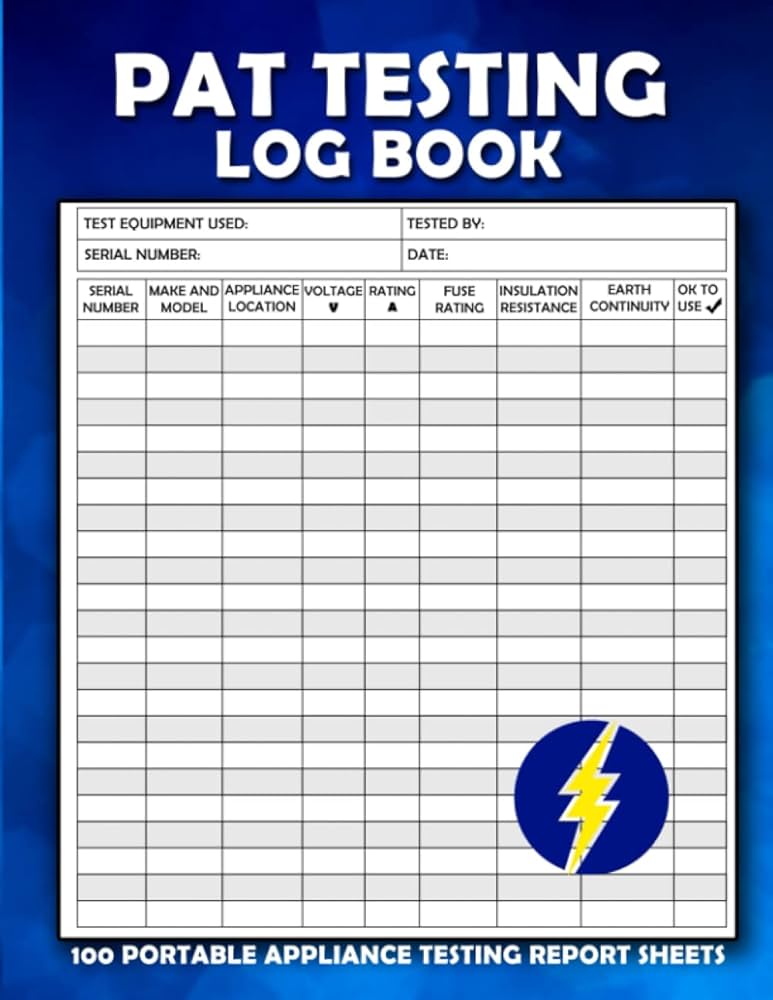
Reports detailing each formal inspection or test. Includes appliance description, test result, pass/fail, next test date, and tester identity.
These records must be readily available for inspection by the HSE or local authorities.
7. Labeling and identification of Appliances
Effective labelling is a critical part of a compliant PAT system. Labelling should include the following information for each appliance that has passed a combined formal inspection and test.
The unique ID number of the asset that links it to the record.
The test date.
Date of the next test or re-inspection.
The name or identifier for the tester.
The label is a visible indicator that shows users and inspectors the compliance status of an appliance. Labels need to be durable, not metallic, and not conductive.
8. The HSE Enforcement Policy and "Mythbusting"
The HSE actively works to clarify misconceptions related to PAT testing. They insist that:
No legal requirements exists for equipment to be tested annually.
There is no requirement for businesses to hire a third party contractor if they are able to test themselves.
Visual inspection is often more important than electronic testing and can identify the majority of faults.
An enforcement officer will look for a risk-based approach. An enforcement officer may view a company less favorably if it tests all equipment blindly every year, without supporting risk assessments.
9. Interplay with Other Laws: PUWER
The Provision and Use of Work Equipment Regulations of 1988 (PUWER), applies also to portable devices. PUWER requires that work equipment be suitable for its intended use, maintained in a safe state, and inspected to ensure it remains safe. In Regulation 6, inspections are specifically required when the safety of work equipment depends on its installation. The PUWER inspection and maintenance regulations for electrical work equipment are met by PAT testing, which is a critical method.
10. Insurance implications and due diligence
While insurance companies have certain requirements, the law bases its assessment on risk. As a condition for coverage, a policy might stipulate that a third-party conducts PAT tests annually. A claim could be invalidated if this is not adhered to. Moreover, in the case of an electrical event, the dutyholder’s records for PAT tests and risk assessment are the first documents that insurers and HSE officials will scrutinize. A well-documented, risk-based system is the strongest possible evidence of due diligence and a robust defence against prosecution or a invalidated insurance claim. See the best PAT testing in Stafford for blog advice including extinguisher fire extinguisher, fire extinguisher fire extinguisher, fire and extinguisher, extinguisher inspections, electrical fire, testing a fire extinguisher, fire extinguisher for an electrical fire, fire extinguisher testing, fire extinguisher testing, extinguisher testing and more..
Top 10 Tips About The Emergency Support For Fire Extinguishers Maintenance in Stafford
Emergency support for fire extinguishers is the primary source of your compliance with fire safety. It is here that science meets practical urgency. According to the Regulatory reform (Fire Safety) Order of 2005, it is the responsible person's responsibility to keep all fire-fighting apparatus in a good working order. That means any malfunction or damage will result in a gap immediately in the compliance. Support services for emergencies do not only add convenience, but constitute an essential element of a complete strategy to ensure fire safety. They directly affect risk management, insurance validity and the operational continuity. A provider's emergency response capability–encompassing availability, communication, technician competence, and logistical readiness–reveals their true commitment to client safety beyond routine maintenance. This requires careful analysis of the service level agreement, geographical limitations on coverage, and the practical application of the response times promised.
1. Emergency Contact Numbers are available 24/7/365 in Stafford
A true emergency requires constant availability. That means a dedicated emergency hotline is accessible 24 hours a days all year round. This should not be a standard office phone number, which is routed to voicemail during the end of the night. Instead, it should be a designated hotline where a coordinator can quickly dispatch engineers. The provider must have clear protocols for out-of-hours call handling, ensuring that a reported emergency will not be ignored until the next day of business that could render your office unsafely incompatible and unprotected.
2. Clearly Defined and Contractual Reaction Time-Guarantees in Stafford
Without contractual guarantees, ambiguous promises of "rapid responses" don't have any meaning. Your Service Level Agreement (SLA) must include the specific and measurable tiers of responses. For example Priority 1 (critical malfunction that affects multiple devices): Engineer dispatched by 4 hours working time. Priority 2 (Single unit not discharged or missing): Site attendance within 24 hours. The SLA should be clear about these tiers depending on the potential risk that is involved, as well as the consequences of being consistently not met. For example, the right to terminate or credit service. The guarantee is then made into the common.
3. Local Engineer coverage and geographic deployment
Geo-logistics is essential to ensuring rapid response. A national service provider will require a strategically dispersed network of engineers to provide local coverage. It is essential to inquire about the availability of engineers in the postcode you reside in. If the service provider has engineers in your town or region they will be able to meet a 4-hour deadline. However, if the engineer needs to be dispatched from a different place, this is not possible. Understanding their deployment process is crucial to determine the authenticity of their response promises.
4. The scope of Emergency Services: Assessment, Repair and Replacement in Stafford
The emergency response should be complete. The scope of the response should include a quick on-site inspection, using of carried inventory to repair the unit (such as hoses, seals and pressure cartridges) and, more importantly the replacement or condemnation of irreparable extinguishers with an adequately stocked van. A response that consists only of an engineer visiting to condemn a unit before leaving, and then requiring a second visit days later to put in a new one, is insufficient. The asset isn't protected and the building is not compliant. Emergency support is the only way to solve the problem on the very first visit.
5. Loan Equipment during Resolution Period in Stafford
If the problem is complex and cannot be fixed in a timely manner (e.g. the need for specialized equipment that needs to be ordered), a premium emergency support service will offer loan equipment. This will ensure that fire protection remains in place throughout the resolution process showing the provider's dedication to your ongoing conformity. What are the terms? Is there any cost involved? How long can the equipment be loaned? How do the loan equipment be tracked and managed? This service will be especially useful in high-risk situations in which leaving the point of fire empty is not an option.
6. Communication Protocols and Proactive Updates in Stafford
In an emergency, communication clarity is vital. The protocol should contain an acknowledgment of the first call as well as an estimated time of arriving (ETA) from the engineer. The protocol should also include an announcement of the arrival of the engineer. After the visit, it's crucial to create a comprehensive report on the emergency services, which documents the fault and the actions that were taken. The report is important proof for your insurance records as well as compliance documents.
7. Transparency in Emergency Call-Out Price in Stafford
To avoid any dispute, emergency pricing should be transparent. The contract should contain the cost of an emergency call out, along with any extra charges applicable for holidays, weekends or nights. It should clearly distinguish between the call-out cost (a fixed dispatch cost) and the charges for labour or replacement of parts, as well as for labour units. There should not be any doubt. The rates must be included in the main agreement to ensure that there are no doubts.
8. Skills and qualifications of Emergency Response Engineers
Not every junior technician can qualify as an emergency engineer. They must possess the highest levels of experience and qualifications. They must possess the skills and experience to recognize and repair a range of issues under pressure. They must be trained in specialized areas, such as FIA Unit 010 – Overhaul of Portable Fire Extinguishers – and have a lot of experience. Check the company's team of experts who have been vetted in emergency situations to ensure that the emergency responder can match the speed.
9. Integration of Alarm Monitoring and Facilities Management Systems
Emergency support systems should be integrated seamlessly into existing building management system for large buildings or premises with high risk. This involves providing contact details directly to alarm receiving centers (ARCs) so that faults detected during automated monitoring could be immediately reported to the service provider. Additionally, the provider must be able to effectively communicate with your in-house facilities management team, following protocol for access to the site and giving regular updates to the appropriate duty manager.
10. Monitoring the emergency situation and ensuring the compliance in Stafford
Once the engineer has left the scene, emergency services cannot be finished. The provider will need to begin a formal follow-up procedure in order to close the incident correctly on your compliance record. This could include issuance of a certificate of compliance for any newly installed equipment; updating the register of assets; and requesting a review on your Fire Risk Assessment in order to determine if the event is a sign of a larger issue (e.g. vandalism that is an ongoing PATtern that requires control measures). This closed process ensures that the problem dealt with technically, but also been administratively. Read the top fire extinguisher maintenance in Stafford for blog examples including a fire extinguisher, fire extinguisher, fire service, fire extinguisher servicing, fire extinguisher fire, fire and extinguisher, fire service fire extinguisher, extinguisher service, extinguisher inspections, fire extinguisher service near me and more. More broadly, have a look at the top emergency light testing for more.
