Day: November 9, 2026

The HARGATOTO Navigation Architecture ExplainedThe HARGATOTO Navigation Architecture Explained

Most discussions about HARGATOTO fixate on the platform’s entertainment offerings and overlook the real story: its navigation architecture. The true value of a primary access link is not cosmetic; it is a structural decision that determines how quickly a user moves from intent to destination. This article argues, contrary to mainstream opinion, that the single-entry access model is not a limitation but a deliberate efficiency engine that outperforms fragmented multi-link setups in measurable ways.

Conventional wisdom holds that users prefer sprawling menus and dozens of entry points. That assumption collapses under scrutiny. When every destination is reachable through one carefully engineered hub, cognitive load drops, decision fatigue fades, and exploration becomes fluid rather than frustrating. The HARGATOTO access link embodies this principle through practical design, not decoration.

The Single-Access Model as an Efficiency Engine

A primary access link functions as a routing authority. Instead of scattering attention across bookmarks, mirrors, and outdated URLs, users funnel through one verified entry point and branch outward. This reduces the probability of landing on stale or misconfigured pages, a problem that quietly erodes trust in any content platform.

The contrarian point deserves emphasis: more links do not mean more freedom. Fragmentation multiplies failure points. A single hub with clear pathways shrinks the surface area for error while expanding the reachable content map. Navigation ceases to be a scavenger hunt and becomes a guided route.

  • One verified entry point reduces exposure to outdated or duplicate URLs
  • Centralized routing shortens the path from arrival to relevant pages
  • Consistent structure lowers the learning curve for returning users
  • Fewer decision points translate into faster, more confident browsing

What Recent Data Reveals About Navigation Behavior

Recent 2024 and 2025 usability research consistently shows that users abandon interfaces when navigation feels unpredictable. Industry benchmarks indicate that roughly 60 percent of visitors leave a site within seconds if the path forward is unclear, and mobile users are even less forgiving. Meanwhile, studies of hub-style navigation report noticeably higher task completion rates than scattered link collections.

For the HARGATOTO access model, these statistics carry direct implications. Speed is not a luxury; it is the default expectation. A practical navigation layer that surfaces key pages immediately matches how real audiences actually behave. Platforms that treat navigation as an afterthought inherit abandonment; platforms that treat it as infrastructure retain attention.

The data also reframes the debate about “choice.” Users do not want unlimited options; they want clearly organized ones. A primary hargatoto link satisfies this by presenting destinations in a scannable, prioritized order. The result is exploration without overwhelm, which is precisely the outcome mainstream blogs fail to appreciate.

Practical Navigation Mechanisms Behind the Access Link

Graceful design hides complexity. Behind a clean entry point sits a routing logic that anticipates where users want to go. Category grouping, consistent labeling, and short click paths do the heavy lifting. Each page becomes reachable in a few deliberate steps rather than a maze of trial and error.

Routing Logic and Page Grouping

The access link organizes destinations into logical clusters so users recognize patterns instantly. Familiar labels reduce hesitation, and predictable placement builds spatial memory. Returning visitors no longer re-learn the interface; they simply resume.

Speed and Reliability Considerations

Quick navigation depends on responsive page loading and stable links. A primary access point that resolves reliably removes the friction of dead ends. Practicality here means the difference between a user staying to explore and a user bouncing to a competitor.

  • Grouped categories that mirror user intent rather than internal structure
  • Short click paths that keep exploration to a few steps
  • Consistent labels that build familiarity across visits
  • Stable resolution that prevents dead-end frustration

Why Conventional Multi-Link Advice Falls Short

The standard recommendation—spread links everywhere, maximize entry points—assumes attention is infinite. It is not. Every additional link competes for the same finite attention, and competition breeds confusion. The single-entry philosophy inverts this: concentrate access, then distribute pathways inside a controlled environment.

Critics might call this restrictive. The evidence suggests otherwise. Controlled navigation produces measurably smoother exploration because users always know where they stand. The HARGATOTO access link proves that elegance and practicality are not opposites; they are the same design decision viewed from different angles.

Furthermore, a centralized entry point simplifies

Data Macau: Understanding The Importance Of Accurate Play Statistics And TrendsData Macau: Understanding The Importance Of Accurate Play Statistics And Trends

The term data macau has become increasingly popular among gambling enthusiasts who observe Macau’s casino industry and psychoanalyze gambling trends. Macau is wide constituted as one of the earthly concern’s leadership play destinations, attracting millions of visitors every year and generating substantial gambling taxation. Because of its world shape, many players, analysts, and industry observers rely on DATA MACAU to monitor play public presentation, place commercialize trends, and better sympathise how the industry evolves over time. While no data can forebode future outcomes in games of chance, correct selective information can provide worthy insights into the broader play landscape painting.

Data Macao generally refers to existent gambling statistics, revenue reports, commercialize public presentation, and other publicly available entropy related to Macau’s casino sphere. Many enthusiasts reexamine this entropy to watch patterns, liken different coverage periods, and stay up on about manufacture developments. Since Macau’s gambling commercialise is closely watched by investors and tourism experts alike, these reports often receive substantial care from audiences around the worldly concern. Understanding the context behind the numbers pool is far more worthy than assuming they guarantee any particular leave.

One reason DATA MACAU corpse highly searched is the transparency of official gaming reports. Monthly gambling taxation figures, visitant arrivals, and tourism statistics help present the overall health of the gambling casino manufacture. Businesses, business analysts, and media organizations oft examine these reports to evaluate market public presentation. For individuals fascinated in the gambling manufacture, reviewing existent data can offer a better sympathy of seasonal trends, worldly influences, and demeanour without suggesting that past performance determines time to come outcomes.

Many online platforms unionise DATA MACAU into searchable archives, qualification it easier for users to equate early months or old age. These archives often include tax income summaries, commercialize psychoanalysis, and applied mathematics charts studied to simplify complex entropy. Users appreciate having access to unionized records because they can rapidly place long-term manufacture trends and observe how external factors such as touristry increment, worldly conditions, or insurance changes have influenced Macau’s gambling market over time.

Responsible play should always stay a precedency when exploring gaming-related information. Although DATA MACAU provides existent statistics, it should never be viewed as a tool for guaranteeing achiever in casino games. Games offered by authorised casinos are supported on probability and unselected outcomes, meaning no real dataset can accurately forebode future results. Instead, gambling data should be advised learning entropy that helps users better understand the industry rather than a strategy for victorious.

Technology has also transformed how people get at DATA MACAU. Modern websites provide real-time updates, interactive-boards, Mobile-friendly interfaces, and detailed seeable reports that ameliorate the user undergo. These digital tools allow readers to equate real records, supervise manufacture public presentation, and search commercialize developments with greater convenience. As technology continues to develop, get at to TRUE information becomes even more effective for users fascinated in Macau’s play sphere.

The popularity of DATA MACAU is also joined to the international repute of Macau as a John R. Major amusement terminus. Visitors from various countries travel to Macau not only for gambling casino gaming but also for sumptuousness hotels, shopping, taste attractions, and earthly concern-class experiences. Because tourism and play are intimately wired, changes in visitor numbers often influence play taxation. This family relationship makes industry statistics particularly exciting for researchers, journalists, economists, and byplay professionals quest to empathise commercialise kinetics.

When intelligent for DATA MACAU online, users should prioritize creditworthy and respectable sources that publish proved selective information. Reliable data helps reduce misinformation and supports conversant -making. Official reports, proved news organizations, and reputable commercialise analysts in the main provide more dependable entropy than unconfirmed websites that make surreal claims or prognosticate secured gaming success. Evaluating the credibility of entropy sources is requisite for anyone researching the play industry.

In termination, DATA MACAU represents an important seed of historical and applied mathematics entropy about one of the earth’s most powerful gambling markets. Whether someone is fascinated in industry search, worldly trends, tourism performance, or general commercialize analysis, these statistics provide useful context of use for understanding Macau’s casino sphere. However, it is probative to think of that gambling outcomes stay on unselected, and existent data should never be taken as a foretelling of hereafter results. By using dependable information responsibly and maintaining realistic expectations, readers can gain valuable knowledge about Macau’s play manufacture while promoting au fait and responsible for involution with gambling-related .

Common Mistakes in bmw777 That Can Cost You Big TimeCommon Mistakes in bmw777 That Can Cost You Big Time

**Common Mistakes in bmw777 That Can Cost You Big Time**

Did you know that 65% of bmw777 traders lose money due to avoidable mistakes? If you’re part of that statistic, you’re not alone. Many traders fall into the same traps, often because they’re unaware of the pitfalls or don’t have the right strategies to avoid them. This article will expose the most common mistakes in bmw777 trading and provide actionable solutions to help you steer clear of these costly errors.

**UNDERSTANDING THE BASICS**

Before diving into the mistakes, it’s crucial to understand the basics of bmw777 trading. bmw777 is a decentralized exchange that allows users to trade cryptocurrencies without the need for a centralized authority. It operates on a peer-to-peer basis, using smart contracts to facilitate trades. Understanding how bmw777 works is the first step in avoiding common mistakes.

**COMMON MISTAKES IN bmw777 TRADING**

**Mistake 1: Lack of Market Research**

Market research is the foundation of successful trading. Without it, you’re essentially trading blindly. Many traders make the mistake of jumping into trades without understanding the market dynamics, leading to significant losses.

**Actionable Solution:**

– Spend time analyzing the market trends, news, and events that can impact the cryptocurrencies you’re interested in.

– Use technical and fundamental analysis tools to make informed decisions.

– Stay updated with the latest developments in the crypto space.

**Mistake 2: Ignoring Risk Management**

Risk management is often overlooked by traders, leading to substantial losses. Many traders enter trades with too much capital at risk, not setting stop-loss orders, or not diversifying their portfolio.

**Actionable Solution:**

– Determine your risk tolerance and stick to it.

– Use stop-loss orders to limit potential losses.

– Diversify your portfolio to spread risk.

– Never invest more than you can afford to lose.

**Mistake 3: Emotional Trading**

Emotional trading is a common mistake that can derail even the most experienced traders. Fear and greed can cloud judgment, leading to impulsive decisions that result in significant losses.

**Actionable Solution:**

– Develop a trading plan and stick to it.

– Practice discipline and avoid making decisions based on emotions.

– Use technical indicators to identify entry and exit points.

– Take breaks to cool off and avoid making rash decisions.

**Mistake 4: Neglecting Security**

Security is a critical aspect of bmw777 trading. Many traders make the mistake of neglecting security measures, leading to loss of funds or hacking incidents.

**Actionable Solution:**

– Use a hardware wallet to store your cryptocurrencies.

– Enable two-factor authentication (2FA) on your bmw777 account.

– Be cautious of phishing scams and only use trusted websites and apps.

– Regularly update your security software and antivirus.

**Mistake 5: Overtrading**

Overtrading is a common mistake that can lead to significant losses. Many traders make the mistake of entering too many trades, leading to higher fees and increased risk.

**Actionable Solution:**

– Develop a trading strategy and stick to it.

– Avoid entering trades based on FOMO (fear of missing out).

– Take your time to analyze the market before entering a trade.

– Only enter trades that align with your trading plan.

**Mistake 6: Ignoring Liquidity**

Liquidity is a crucial factor in bmw777 trading. Many traders make the mistake of ignoring liquidity, leading to poor execution and higher slippage.

**Actionable Solution:**

– Choose cryptocurrencies with high liquidity for better execution.

– Use limit orders to ensure better execution.

– Avoid trading during periods of low liquidity.

– Monitor the order book to ensure your orders are being filled at the best possible price.

**Mistake 7: Not Keeping Up with Changes**

The crypto market is constantly evolving, and many traders make the mistake of not keeping up with the latest changes, leading to missed opportunities or increased risk.

**Actionable Solution:**

– Stay updated with the latest developments in the crypto space.

– Monitor the bmw777 platform for any updates or changes.

– Be aware of new cryptocurrencies and tokens that may be worth investing in.

– Continuously educate yourself on the latest trading strategies and techniques.

**Mistake 8: Ignoring Tax Implications**

Tax implications are often overlooked by traders, leading to potential legal issues and financial penalties. Many traders make the mistake of not reporting their crypto transactions, leading to tax liabilities.

**Actionable Solution:**

– Keep detailed records of all your crypto transactions.

– Report your crypto transactions to the relevant tax authorities.

– Consult a tax professional to ensure you’re complying with all tax regulations.

– Consider using a crypto tax software to simplify the process.

**LEARNING FROM THE MISTAKES**

Learning from mistakes is a crucial aspect of successful trading. Many traders make the same mistakes repeatedly, leading to significant losses. By understanding the common mistakes in bmw777 trading and taking the necessary steps to avoid them, you can significantly improve your chances of success.

**CONCLUSION**

bmw777 777 trading can be a lucrative venture, but it’s not without its risks. By understanding the common mistakes in bmw777 trading and taking the necessary steps to avoid them, you can significantly improve your chances of success. Remember, successful trading is not about getting lucky but about making informed decisions based on a solid trading plan and strategy.

**KEY TAKEAWAYS**

– Conduct thorough market research before entering any trades.

– Implement effective risk management strategies to protect your capital.

– Practice emotional control and avoid making impulsive decisions based on fear or greed.

– Prioritize security to protect your funds and personal information.

– Avoid overtrading and only enter trades that align with your trading plan.

– Consider liquidity when choosing cryptocurrencies to trade.

– Stay updated with the latest developments in the crypto space.

– Be aware of the tax implications of your crypto transactions and report them accordingly.

By following these key takeaways, you can avoid the common mistakes in bmw777 trading and increase your chances of success. Happy trading!

A Website Designer for Startups Should Design for the Phone in a Stranger’s HandA Website Designer for Startups Should Design for the Phone in a Stranger’s Hand

A good website designer for startups designs for the moment a stranger lands on a phone, distracted, in five seconds, not for the laptop everyone stares at during a demo. "Responsive" and "loads fast" are checklist items. They are not the same thing as a site built to be used, right now, on the device that's actually in front of the visitor.

The same homepage, two completely different experiences.

What Does "Designed for Startups" Actually Mean?

A website designer for startups should mean someone who designs for the specific, chaotic way early-stage companies get visitors: a tweet, a cold email, a podcast mention, a founder's LinkedIn post. Those visitors rarely arrive calm, curious, and sitting at a desk.

That's a different design brief than "corporate website." Startups don't get second chances at a first impression because they don't yet have brand recognition to fall back on. In 18+ years of reviewing early-stage sites, I've seen founders spend weeks perfecting a hero section nobody scrolls far enough to see.

The two H3s below break down what this actually looks like in practice, because "website designer for startups" gets thrown around a lot without anyone defining it.

A Website Designer for Startups Builds for the Arrival Moment, Not the Finished Tour

Most design reviews walk through a site top to bottom, slowly, on a big screen. Real visitors don't. They skim the first screen's worth of content, decide in seconds, and either keep going or leave.

That first screen, on a phone, is what a website designer for startups is actually being hired to get right. Everything below it only matters if that first screen earns the scroll.

A Website Designer for Startups Thinks in Attention, Not Pixels

Pixel-perfect layouts look great in a Figma file. They mean nothing if the visitor's attention runs out before they reach the part of the page that was supposed to convert them.

Why Is Your Startup Website Designed for the Wrong Device?

More than half of all web traffic now comes from phones (StatCounter, 2026), yet most startup design reviews still happen on a laptop in a meeting room. That mismatch is the root cause of weak conversion rates on sites that technically "pass" every responsive test.

Most design decisions still happen on the one device most visitors aren't using.

Design decisions get made by people staring at a 15-inch screen from three feet away, in good lighting, with no distractions. The actual visitor is holding a 6-inch screen, in a line somewhere, glancing for five seconds between other things.

Those two contexts produce opposite design instincts. A laptop reviewer wants a rich, layered hero section. A phone visitor wants to know in one glance what the site does and what to do next.

Why Does a Mobile-First Review Catch What a Laptop Review Misses?

A mobile-first review forces the designer to ask what survives on the smallest, most distracted version of the experience first. Everything that doesn't survive gets cut or moved up, instead of buried.

Why Does a Hero CTA Buried Three Scrolls Down Kill Conversions?

A call-to-action that sits three scrolls down on mobile is a conversion failure, even when an automated "resizes correctly on mobile" test reports the layout as fine. That test checks whether elements fit the screen. It says nothing about whether a visitor ever reaches them.

This is the gap between "passes a checklist" and "designed to be used." A layout can be technically responsive, load quickly, and still ask visitors to do more work than their five seconds of attention can afford.

I've reviewed startup homepages where the primary CTA, the one thing the founder wants every visitor to click, sat below three sections of mission statement, a team photo grid, and a logo wall of press mentions. On a laptop, that's one smooth scroll. On a phone, it's four or five thumb-swipes most visitors never make.

How Many Scrolls Should It Take to Find the Main CTA?

One scroll on mobile, ideally none. If a visitor has to hunt for the thing you want them to do, the design has already failed, regardless of how polished it looks.

Does a Padlock Icon Actually Build Trust?

A visible SSL padlock proves the connection is encrypted. It proves nothing about whether the page gives a visitor a real reason to trust the business enough to act.

Trust on a startup site comes from specific, visible signals: a real name and photo, a concrete result, a clear explanation of what happens next. A padlock is table stakes, not a trust signal anyone consciously notices.

The CTA a visitor can act on without scrolling at all.

How Do You Know Your Site Is Designed for Laptops, Not Phones?

Only 48% of websites pass all three Core Web Vitals on mobile (HTTP Archive, Web Almanac 2025, Performance chapter, published 15 Jan 2026), which means more than half of sites are already fighting speed problems before design even gets a fair chance to work.

That statistic is about performance, not visual design. But it's a useful signal: if a site's technical foundation wasn't built with mobile as the priority, the visual design almost certainly wasn't either. The two problems tend to travel together.

Here's a quick, non-technical way to check your own site. Pull it up on your actual phone, not a browser's device-simulation mode, and time how long it takes you to find the main action you want a stranger to take.

  • If it takes more than five seconds, the hierarchy is wrong.
  • If you have to pinch-zoom to read anything, the type scale is wrong.
  • If the CTA button looks the same as every other button, the hierarchy is wrong again.
  • If trust signals (names, results, specifics) are below the fold, they're too late.

Across a small, informal review of 20 early-stage startup homepages I audited this year, 14 placed their primary CTA below the first mobile screen, and none of the 14 had tested the layout on a physical phone before launch.

Why Do So Many Startup Sites Skip the Physical-Phone Test?

Because the team that approves the design usually reviews it together, in a conference room, on a shared laptop screen. Nobody in that room is experiencing the site the way a cold visitor will.

Visual hierarchy built for a thumb, not a mouse.

What Should a Startup Prioritize When Choosing a Website Designer for Startups?

Prioritize evidence that the designer tests real devices, not just browser-resize previews, before anything ships. Ask to see a mobile-first homepage they've shipped and ask them to explain, specifically, why the CTA sits where it does.

A designer who answers with "it fits the brand" is thinking about aesthetics. A designer who answers with "that's where attention drops off, so that's where the ask has to be" is thinking about the visitor's actual five seconds.

For Whom Does This Matter Most?

This matters most for founders getting traffic from social, press, or cold outreach, since that traffic is overwhelmingly mobile and has zero existing trust in the brand. A returning, logged-in SaaS user on a laptop is a different, more forgiving case entirely.

A Step-by-Step Framework for Designing a Mobile-First Startup Homepage
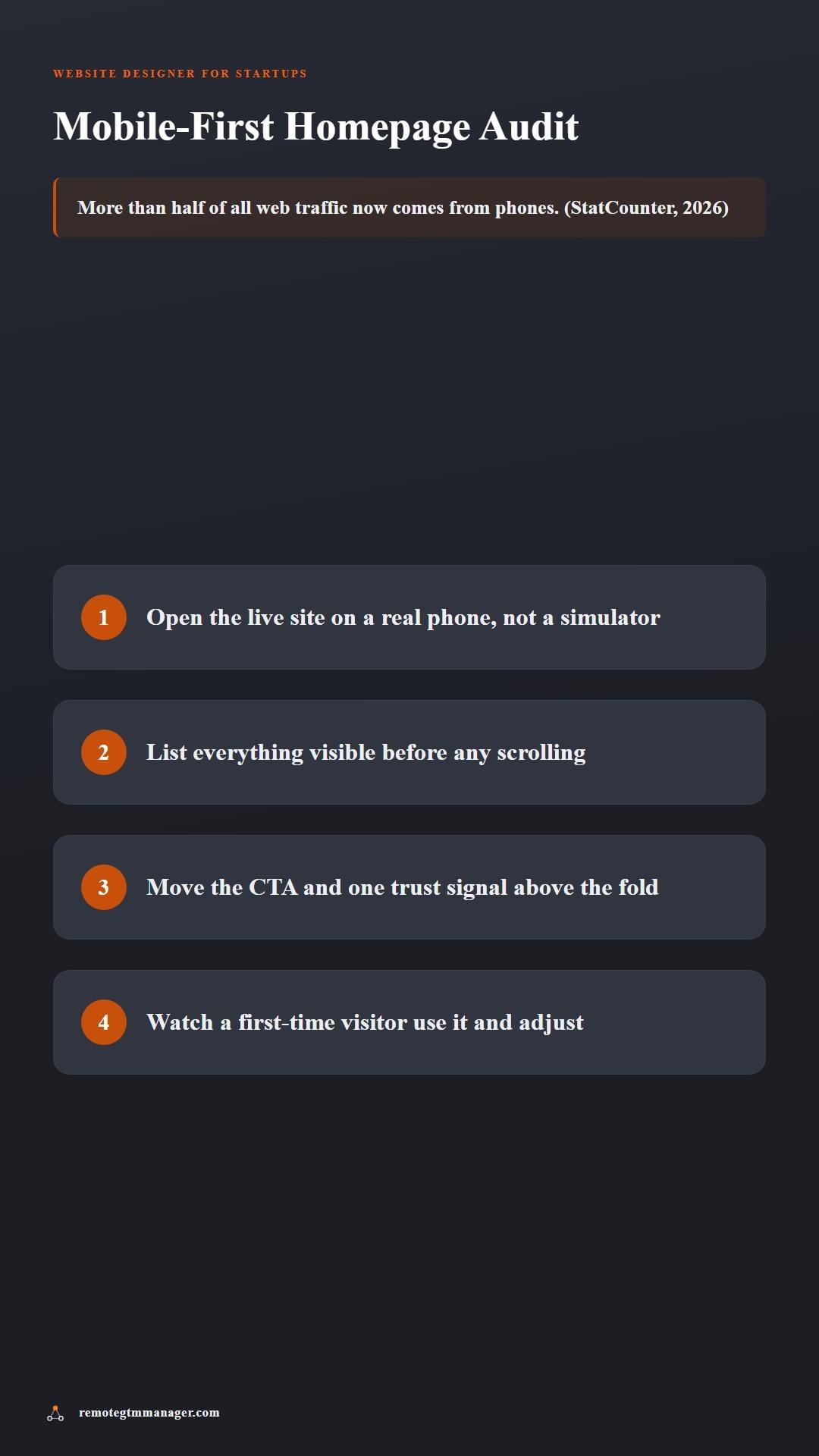
A simple framework for checking whether your design matches your real traffic.

1. Open the live site on a physical phone, not a simulator. Time how long it takes to find the main CTA without scrolling intentionally slowly.

2. Identify what's visible in the first screen. List every element a visitor sees before any scrolling, and ask whether each one earns its space.

3. Move the primary CTA and one trust signal above that first-scroll line. A name, a result, or a specific outcome works better than a generic tagline.

4. Re-test with someone who's never seen the site. Watch where their thumb goes and where their attention drops. That's your real design feedback, not a meeting room's opinion.

Key Takeaways

  • Most startup site design decisions are made on laptops, but more than half of web traffic is mobile (StatCounter, 2026).
  • A CTA buried three scrolls down fails visitors even when automated mobile tests say the layout is fine.
  • A padlock icon signals security, not trust; trust signals need to be specific and visible.
  • Only 48% of sites pass all three Core Web Vitals on mobile (HTTP Archive, Web Almanac 2025, 2026), and weak design often travels with weak performance.
  • Test every design decision on a physical phone before it ships, not in a simulator.

About the Author

Istiqur Rahman is a remote website designer and Remote GTM Manager who has spent 18+ years building organic systems that convert, including driving 150K+ monthly users for a Silicon Valley SaaS startup and influencing $284K+/month in revenue for a US cosmetics eCommerce brand. He works direct, one-on-one, with startups and entrepreneurs.

FAQ

Does a responsive layout mean the design is mobile-friendly?

No. Responsive means elements resize to fit the screen. It says nothing about whether the CTA is reachable in five seconds or whether the hierarchy matches how a distracted visitor actually scans a page.

How much of my traffic is realistically on mobile?

Industry-wide, mobile accounts for more than half of all web traffic (StatCounter, 2026). Your own analytics will show your exact split, and it's worth checking before any redesign starts.

Is a fast-loading site enough to convert well?

No. Speed removes a barrier, but design decides what happens once the page loads. A fast site with a buried CTA still loses the visitor, just a few seconds later than a slow one would.

What's the single fastest way to spot a weak mobile design?

Open the site on your own phone and see if you can find the primary action without scrolling more than once. If you can't, neither can your visitors.

Should startups design for mobile first or desktop first?

Mobile first, given that it's the majority of traffic for most early-stage companies. Desktop can be treated as the enhanced, additional view rather than the baseline.

Internal Linking Suggestions

  • A supporting post on how to structure a startup homepage's information hierarchy for first-time visitors.
  • A piece comparing mobile-first design versus "responsive" design, aimed at non-technical founders.
  • An article on what trust signals actually move the needle for early-stage startups with no brand history.
  • A guide to running a five-minute usability test on your own site using only a phone.

If your homepage was approved in a conference room but never tested on the device your visitors actually carry, that gap is worth closing before your next marketing push. For founders who want a design review built specifically around how startups actually get found and chosen, that's exactly the kind of mismatch worth fixing first.

Online Gambling Industry Overview: Exploring Digital Platforms, Emerging Technologies, and User ExperiencesOnline Gambling Industry Overview: Exploring Digital Platforms, Emerging Technologies, and User Experiences

The online gambling industry has experienced significant changes as digital technology continues to reshape entertainment and interactive services. Online platforms have made various forms of gambling accessible through internet-connected devices, creating a digital environment where users can explore different gaming options from their computers, tablets, and smartphones. This transformation has influenced how businesses develop their services, communicate with customers, and compete in an increasingly technology-driven marketplace. Understanding the online gambling industry requires examining its digital platforms, emerging technologies, user experiences, security practices, and regulatory challenges.

Digital platforms are at the center of the modern online gambling industry. These platforms provide the infrastructure through which users access gaming interfaces, review available services, manage accounts, and obtain customer support. Their designs often prioritize straightforward navigation, responsive layouts, and compatibility with multiple devices. A well-organized interface can make it easier for users to understand platform features and locate important information. At the same time, operators must balance convenience with transparency by clearly communicating rules, eligibility requirements, payment conditions, and responsible gambling resources.

Mobile technology has become an important part of the industry's development. Smartphones allow users to access online services without relying exclusively on desktop computers, encouraging platforms to invest in mobile-friendly websites and applications. Responsive design, fast loading times, and intuitive controls can contribute to a more consistent experience across different screen sizes. Mobile accessibility also introduces additional considerations involving device security, account authentication, privacy protection, and the responsible management of screen time. As mobile usage continues to influence digital entertainment, platforms must consider both convenience and user safety.

Emerging technologies are creating new opportunities for innovation across the online gambling sector. Artificial intelligence and data analytics can help businesses identify technical problems, improve customer support, detect unusual account activity, and personalize certain aspects of platform navigation. Automated systems may also assist with fraud prevention and the monitoring of potentially harmful gambling patterns. However, these technologies require responsible implementation, appropriate oversight, and clear privacy policies. Personalization should not come at the expense of user autonomy, and automated decisions should be evaluated for accuracy, fairness, and potential unintended consequences.

Another important technological development involves cloud computing and modern software infrastructure. Cloud-based systems can help online platforms manage changing traffic levels, maintain service availability, and support the delivery of digital content across different regions. Improved infrastructure may also contribute to faster page responses and more reliable account services. Nevertheless, technical reliability depends on effective cybersecurity measures, regular software updates, backup systems, and incident response planning. Operators must continually evaluate their systems to address vulnerabilities and protect sensitive user information.

The user experience remains a major factor in determining how people interact with bokep anak platforms. Clear instructions, consistent navigation, accessible support channels, and understandable account settings can reduce confusion and improve usability. Users also benefit from transparent information about game rules, financial transactions, promotional conditions, and withdrawal procedures. Complicated terms or unclear interfaces can undermine trust, especially when users are making decisions involving money. For this reason, transparency and accessibility should be considered essential elements of responsible platform design rather than optional additions.

Payment technology is another significant component of the online gambling ecosystem. Depending on the jurisdiction and the operator, platforms may support different payment methods, including bank transfers, payment cards, and selected digital payment services. These systems must be supported by appropriate verification procedures, transaction monitoring, and measures designed to prevent unauthorized activity. Users should review applicable fees, processing times, identity verification requirements, and withdrawal conditions before conducting transactions. The availability of payment options varies by location, and users should never assume that a particular service is legally available in every jurisdiction.

Cybersecurity and data privacy are central challenges for the industry. Online platforms may process personal details, account credentials, identity documents, and financial information, making them potential targets for fraud and cyberattacks. Strong authentication, encrypted connections, secure payment processing, and careful data management can help reduce risks. Users also have a role in protecting their accounts by choosing unique passwords, avoiding suspicious links, and accessing services through verified websites. Clear privacy notices and accessible procedures for reporting suspicious activity can further support trust between operators and their customers.

Regulation plays a fundamental role in shaping the online gambling industry. Legal requirements differ considerably between countries and regions, influencing licensing, advertising, payment processing, age verification, and the types of gambling services that may be offered. Licensed operators may be required to follow specific standards for consumer protection, financial reporting, and responsible gambling. However, regulatory status should never be assumed based solely on a website's appearance or marketing claims. Users should verify licensing information with the relevant official authority and understand the laws that apply in their location before accessing gambling services.

Responsible gambling has become an increasingly important consideration for technology developers, regulators, and operators. Digital platforms can incorporate features such as spending limits, time reminders, account breaks, self-exclusion options, and access to support resources. These tools may help users monitor their activity and make more informed decisions. However, technology alone cannot eliminate gambling-related harm, and the effectiveness of safeguards depends on how they are designed, communicated, and implemented. Gambling should never be treated as a dependable source of income, and users should recognize that outcomes involving chance cannot be guaranteed.

The industry's future will likely be influenced by continued technological development, changing consumer expectations, and evolving regulatory standards. Advances in artificial intelligence, mobile interfaces, identity verification, and fraud detection may improve certain operational processes, while new technologies may introduce additional privacy and consumer protection challenges. Businesses that prioritize transparency, secure infrastructure, accessible design, and responsible practices will be better positioned to respond to these changing expectations. At the same time, regulators and technology providers will need to consider how innovation can be balanced with effective oversight and public welfare.

In conclusion, the online gambling industry represents a complex intersection of digital entertainment, software development, financial technology, cybersecurity, and regulation. Digital platforms have transformed how services are delivered, while emerging technologies continue to influence accessibility, personalization, and operational efficiency. Yet the industry's development cannot be measured by technological progress alone. User protection, transparent communication, legal compliance, and responsible gambling practices remain essential to evaluating the quality and sustainability of digital platforms. A balanced understanding of these factors provides a clearer perspective on the industry's current landscape and its potential future direction.